Hi, Pablo here
How much hashrate does a fork chain need?
Published: 2026-10-25
Ever since the BIP-110 chain failed, a few concerns have been bouncing around in my head (to be clear, they have nothing to do with the ideas behind BIP-110). What caught my attention was how it failed, and what that says about the power miners hold over Bitcoin now.
This post is the current state of my thinking. It is work in progress, and I'd love to be told where I'm wrong.
BIP-110 tried and died
When BIP-110 split off, its chain got so little hashrate that not even the fanatics stayed for long. It mined 8 blocks and was definitively abandoned within 20 days. On the first day, poolcoin (I'll call "normal" Bitcoin that for fun) already got ahead significantly. By day 3 it was pretty much a closed case.
The interesting part is that this behaviour was very decoupled from the social acceptance of BIP-110. BIP-110 was far from any majority of proactive support, but I personally estimate somewhere around 5-20% of the network was supportive of it, and the rest was mostly neutral. But its brutal death after the chainsplit was not reflective of this. Why didn't all the fanatics stick around? Because there was no shortage of them. We know because now they've all moved on to Blakecoin. Those guys were willing to run BIP-110 to the ultimate consequence of splitting from the world, but still, they left the BIP-110 chain. Why? Because the chain was simply unusable:
- blocks took days to arrive, not minutes, and
- the difficulty adjustment that could have fixed that sat years in the future.
Believers walked away from the chain they believed in, because using it was impossible.
What actually concerns me
That episode made something concrete for me: hashrate is decoupled from nodes and users, and hashrate (or the lack of it) can be used to make a chain unusable, whatever its users think of it ideologically/politically.
Put that together and you get a loop:
- Low hashrate → long blocktimes, and a long wait for the difficulty adjustment.
- Long blocktimes → the chain is too slow to transact on.
- Too slow to transact → users who hold and depend on bitcoin leave the chain.
- Fewer users → less reason to mine it → even less hashrate.
Mining is heavily centralized in a handful of pools. That means a mining cartel could trigger this loop on any chain it chooses to starve.
So I set out to answer some questions with numbers:
- In a chainsplit, how does a chain's share of hashrate affect the experience of the people using it? What counts as "too little" hashrate, and what counts as "too long" a blocktime?
- Given today's mining pool concentration, which combinations of pools have the power to keep a fork chain alive, or to kill one?
Why a minority chain is so slow
When a chain splits, both sides keep the difficulty they had at the moment of the split. Suppose one side ends
up with a share h of the hashrate. Then:
-
Blocks arrive
1/htimes slower. Half the hashrate means 20-minute blocks; a tenth means 100-minute blocks. -
It stays that slow until you mine 2016 blocks, the next adjustment. At
1/hthe usual speed, that takes14/hdays instead of the usual two weeks. - Even then, relief is partial: each adjustment can cut difficulty by at most 4×. A very weak chain needs several adjustments, each one arriving sooner than the last, before it is back to 10 minutes.
Here is what that looks like:
| Hashrate | Time between blocks | First adjustment | Back to 10 min |
|---|---|---|---|
| 50% | 20 min | 28 days | 28 days |
| 25% | 40 min | 56 days | 56 days |
| 10% | 1.7 hours | 140 days | 175 days |
| 5% | 3.3 hours | 280 days | 1.0 years |
| 1% | 16.7 hours | 3.8 years | 5.1 years |
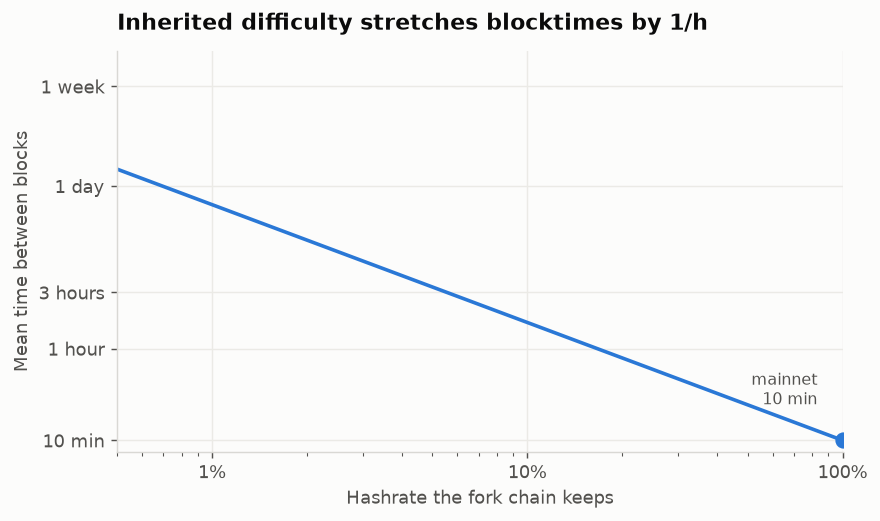
The second column is what hurts, and the third is for how long it's going to hurt. Things become worse given the importance of expectations: if users think a chain won't be usable in the future, even if it's barely usable now, they will drop it anyways due to expectations, which triggers a doom loop.
Who uses the chain, and how long will they wait?
"Usable" means different things to different people, so I modelled three personas, each with a tolerance for how long they're willing to wait for a transaction to reach 3 confirmations, which for simplicity we will define as settled.
| Persona | Who they are | Will wait for 3 confirmations |
|---|---|---|
| Hodler | Holds, rarely moves coins | 1 week |
| Medium of exchange | Pays and gets paid | 1 day |
| Institution | Settles business on a schedule | 3 hours |
Since block arrival is random, a wait isn't a single number but a distribution. Sometimes you get lucky, sometimes you don't. I settle that with a service level: at p90, 90% of a persona's transactions must reach 3 confirmations within its tolerance. On the regular 10 min schedule, that p90 wait is about 53 minutes (read as: 90% of times, you will see three blocks confirmed in under 53 min).
Assumptions
To keep this tractable, I assume:
- 3 confirmations count as final.
- Static hashrate: each side keeps its share of hashrate for good.
- Empty mempool: no fee competition, no queueing. This is the best case scenario: if you start facing a clogged mempool, waits would be even longer for some.
- The split starts at the beginning of a difficulty period, so the minority chain has a full 2016 blocks to grind through before any relief. Note that changing this can greatly influence the delay to the first difficulty adjustment, but I won't explore this further since for now it seems canonical that fork activations happen on the start of difficulty periods.
- Out of scope: introducing the effects of hard forks of any kind, or more generally anything that tampers with the difficulty adjustment.
The numbers
Turning tolerances into hashrate is simple division. If a persona tolerates waits k times longer
than mainnet's, the chain can be k times slower, so it needs 1/k of the hashrate. This
is the share of total hashrate a chain needs to keep each persona on it:
| Persona | Tolerance | p50 | p90 | p95 |
|---|---|---|---|---|
| Institution | 3 hours | 14.86% | 29.57% | 34.98% |
| Medium of exchange | 1 day | 1.86% | 3.70% | 4.37% |
| Hodler | 1 week | 0.27% | 0.53% | 0.62% |
Institutions are demanding: a chain needs roughly 30% of all hashrate before they'll use it. Everyday spenders need under 4%, and hodlers need about half a percent.
Defensive coalitions: who can keep a fork chain alive?
Now map those bars onto today's mining pools. If a group of pools wants to keep a minority chain usable, how many does it take?
| Persona | Needs | Smallest coalition today |
|---|---|---|
| Institution | 29.57% | 2 pools (e.g. Foundry USA + AntPool) |
| Medium of exchange | 3.70% | 1 pool (any of the top 7) |
| Hodler | 0.53% | 1 pool (any of the top 14) |
A single mid-sized pool committing to a chain is enough to keep it usable for hodlers and everyday spenders. A couple make it workable even for the hypothetical institutions.
Offensive coalitions: who can force users onto a softfork?
Now flip it around, because this is the scenario that worries me.
A coalition of pools activates a softfork that users don't want. The users reject it and stay on the chain without it, or even push for a URSF. That chain is left with whatever hashrate the coalition didn't take. If that falls below the users' bar, the chain they want becomes unusable by their own standards, and they're forced to either jump across to the cartel softfork, or hardfork away like the Blake boys did.
| Persona | Softfork side must hold | Smallest coalition today |
|---|---|---|
| Institution | over 70.43% | 4 pools (the top four, 72.34%) |
| Medium of exchange | over 96.30% | 11 of 18 pools |
| Hodler | over 99.47% | 14 of 18 pools |
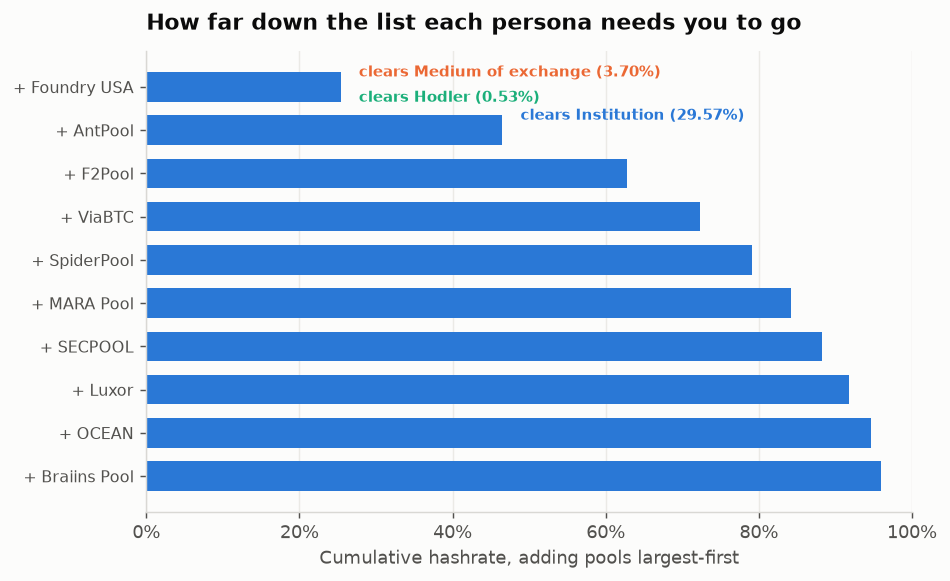
If you consider AntPool to actually be AntPool and friends, then you only need the three top pools today to bend institutions into a softfork, which you could argue already creates enough gravity across miners and users that everyone will end up in the softfork chain.
The scenario that scares me
Here's the nightmare, using the numbers above:
- Foundry, AntPool & friends, and F2Pool, about 72% of hashrate between them, sponsor a softfork that sets the minimum fee to 5 sat/vB.
- They go hard on propaganda: "stand aside, lady, it's for the security and future of the network."
- They set a short deadline that barely gives the community time to react, say four weeks.
- The rest of the network doesn't want this. But the rest of the network doesn't have the hashrate to keep a user-activated chain usable, at least not for anyone who needs transactions to settle within hours.
- For most users, paying 5 sat/vB is a lesser evil than risking the run-for-your-life scenario of jumping into a hard fork (to make matters worse... which one?). And staying in the "old" chain is not feasible since it will die starved of hashrate.
Nothing in that scenario requires breaking Bitcoin's rules. It only takes a few pools agreeing with each other, and the loop from the start of this post does the rest. It's a fuck up in Bitcoin's design, and as far as my knowledge goes, it's been here since the chain got started. We're just starting to see it emerge now.
The solution
I have no solution for this. It somehow feels all the forces are pointed at making this worse. The only "happy scenario" is Bitcoin gets slowly destroyed like email did, we lose all the usefulness it was giving us, and we're back at square one. The community with the ethos (supply capped, permissionless, decentralized freedom money) needs to start from scratch with some new coin/solution, with all the challenges that come with it. We could be locked in fiat hell for decades before we pull it off.
Or perhaps the Blake boys will somehow make it. I have little faith but I wish them the best.
Code
You can find the repo where I worked this out here.