Hi, Pablo here
My first petahash
Published: 2026-04-16
I've recently started mining Bitcoin at a scale I never had before, so I thought it would be interesting to jot down a few observations on my recent errands.
My friend Unhosted Marcellus has been following closely the evolution of the OCEAN mining pool since its launch. I hadn't used it personally until recently, so for years all the info I had on it was second hand. What he was most excited about was the DATUM Gateway: the great innovation is that you are building your own block templates, which is something no other pool does. By using OCEAN with DATUM, you enjoy the benefit of more stable mining rewards as opposed to lotto mining, while still being a sovereign miner in the sense that you rely on your own node and you do your own templating. Great news for decentralization.
The reason I had not bothered with setting all of this up so far was... that I really don't mine much. I got gifted a cute Bitaxe Supra from the Bitronics Shop that produces some humble 600GH/s, so it felt pointless to do all the setup for such a tiny hashrate.
But then, Unhosted Marcellus started to tell me about these new markets started by Braiins called Hashpower. Other articles explain the market better, so I'll leave it up to you to find those to learn about it. Although I must say, if learning is what you want, nothing beats using it. The TLDR is that you can sign up, send sats, and rent hashrate that you can point to your own DATUM gateway. And the surprise (at least for me) is how you can literally rent petahashes for peanuts, when you account for the fact that most of the sats you put towards buying hashrate will come back as mining rewards.
Unhosted finally triggered me with this tweet. Cheeky bastard.
I started toying around with a few PH/s, eventually trying out double digit petahashes. There is this funny feeling to suddenly be controlling the equivalent of tens of thousands of little bitaxes.
The economics around it are interesting. The bidding prices in Hashpower are usually (not always!) above hashvalue. It's common to pay a 1%-5% premium over hashvalue. So, the most probable thing is that you end up operating at a small loss. This is not strictly guaranteed if you mine with OCEAN, since the luck factor is important and can easily swing rewards +-10%. So unless you mine at a stable rate with a months-long time horizon, luck is going to play a more important role than the premium on the hashrate.
To optimize your outcome, it is important to constantly update your bids in Hashpower. Bids are set at a fixed price in sats, so as the market auction moves every few seconds, you will be either overpaying or end up unserviced.
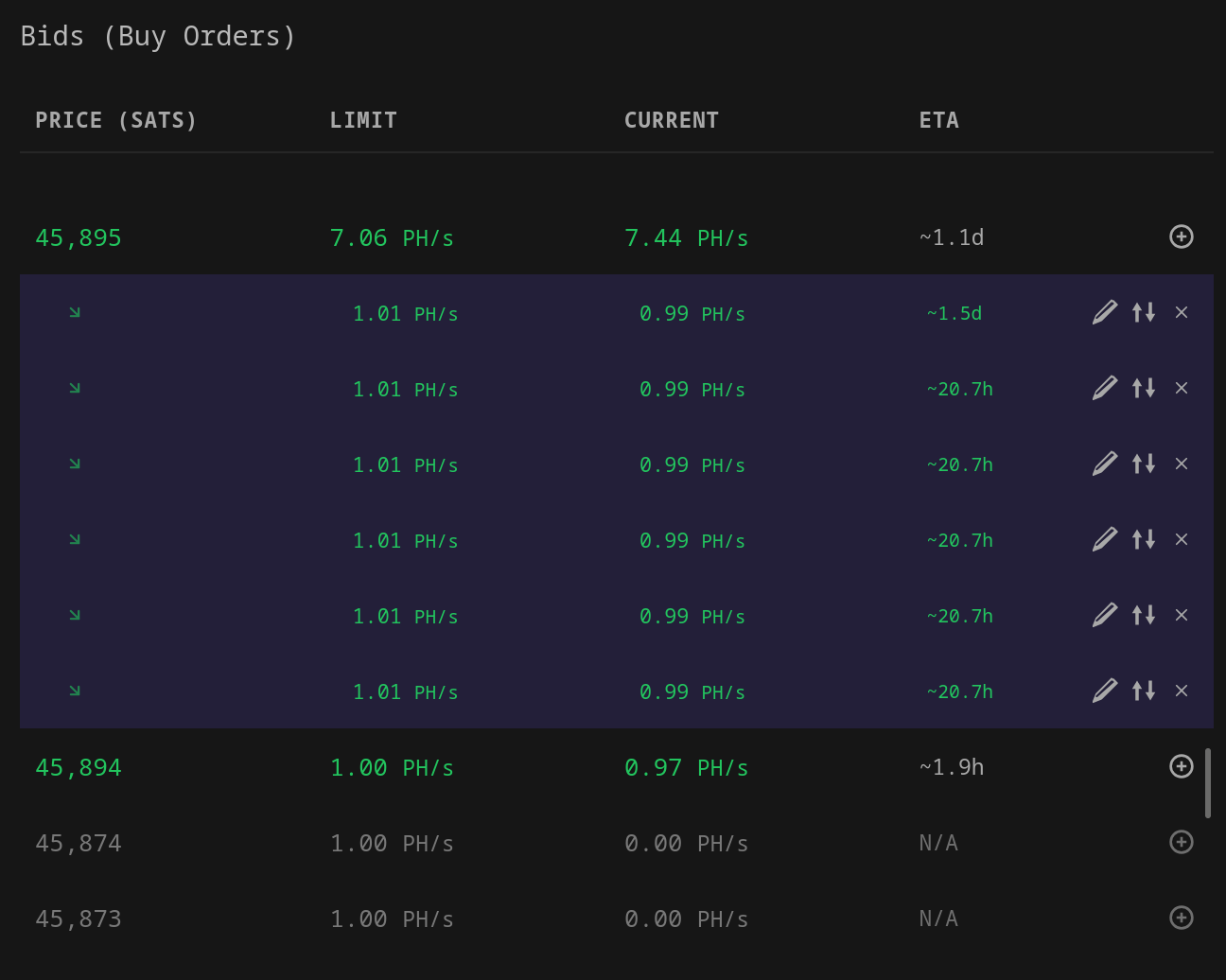
On the first days I was using Hashpower, I would log into it multiple times a day to adjust my bids to stay at the right height of the order book. At first it was fun, then it felt tedious, and it started to generate this Twitter-esque addiction feeling I didn't like. I quickly concluded I wanted to automate this out so my only task was to contemplate how pretty my OCEAN hashrate dashboard looked like, and I could leave behind pulling levers in Hashpower's webpage like a financial monkey.

I solved this problem for myself with hashbidder. It's a small CLI tool that I run every couple minutes with cron. The TLDR is you can give it a config file that reads "I want to mine at 5PH/s" and the tool will set your bids with two goals in mind:
- To bring your hashrate in line with your goal (e.g. if you want to be at 5PH/s, and you're currently averaging 3PH/s in the last 24 hours, it will drive your bids to a total of 7PH/s. If instead, you're scoring an average of 10PH/s, it will stop your bids completely to let your average go lower).
- To pay as little as possible, but guarantee you get served. The logic here is to set the price right above the cheapest bid that is being served currently.
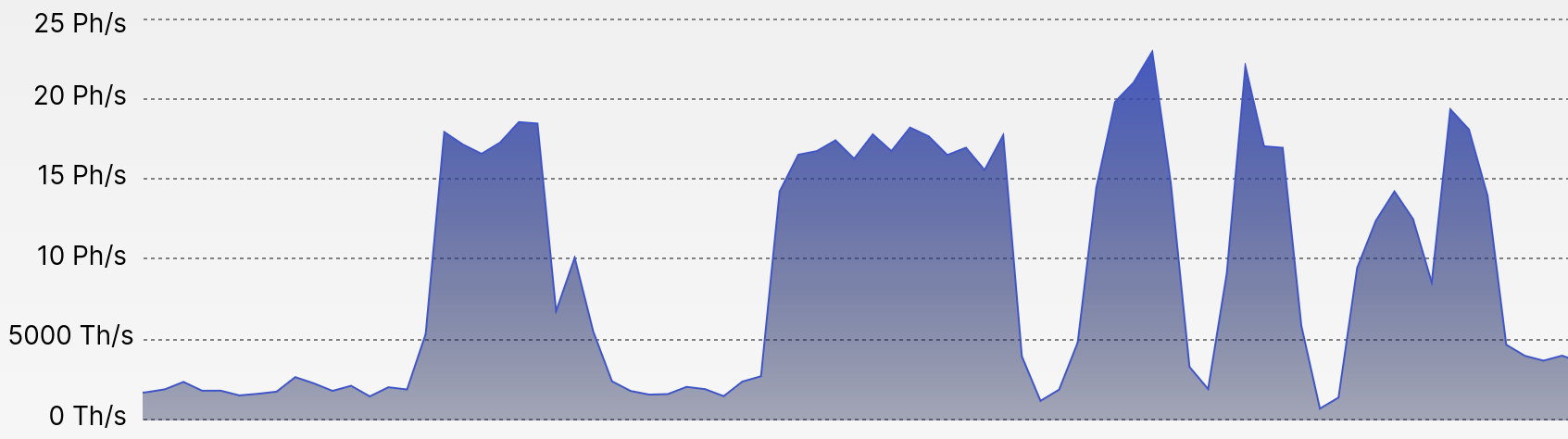
The result is quite pleasant. Delivery is choppy because, even with frequent updates, trying to be cheap means you often get dragged into being overbid by others and you stay there for some minutes. But the self-adjusting hashrate compensates for it: if you've been falling behind a lot recently, hashbidder will just hash at a higher hashrate to make up for it. I'm currently targeting 5PH/s, and this is what my OCEAN hashrate timeline looks like.

There are still a few more optimizations I'll add to hashbidder to reduce cost and decrease the volatility of delivery, but they're just marginal improvements. The gist of it is already there and it's doing its work fine.
My next steps are simply to sit and watch. I've decided I will pour 10 million sats during a few months into this setup and then stop to measure what my rewards have totalled to, so I can provide people interested in this with a real-life report of how everything turned out.
Overall, I'm having lots of fun. Setting this up made me excited in a way that felt oddly similar to the first time I was setting up lightning nodes. The night I started out my DATUM gateway and pointed some hashrate to it felt like the night I spun up an LND and started doing some lightning triangles in Lightning Network+.
Some interesting links in case you want to learn more or give it a shot at mining with rented hash yourself:
- rentsomehash.com, guides on how to set up your DATUM gateway and start mining with rented hash
- A video guide from Matthew Kratter: on X
- You can check what Unhosted tweets here, since he's pretty much obsessed with this and doesn't pay attention to anything else: https://x.com/oomahq. Also, some podcasts and articles from him. Many kudos for starting this fire: