Hi, Pablo here
10 million sats into mining
Published: 2026-05-25
In my previous article My first petahash I discussed my beginnings with mining via rented hashrate from Braiins' Hashpower market plus my own DATUM gateway pointing to OCEAN, with hashbidder to automate my bidding in the hashmarket. I also mentioned that my starting plan was to put a total of 10 million sats into this experiment then checkpoint how things were going. Well, the 10 million sats have gone through Hashpower (and partially come back to me), so I'll deliver the checkpoint as I promised myself.
Before going into it, I want to share my rationale for writing and sharing this. Most stuff I fiddle and tinker with, I don't write about publicly. But this experiment is different. Although simply setting this up and mining is plenty of fun and pretty much justifies doing it by its entertaining nature, the reality is that my interest in controlling hashrate goes beyond sweet weekend hacking fun. Truth is that the BIP110 softfork is on the table, and its success will depend on people adopting it and hashrate being deployed to support it. My node has been running with the BIP110 patch for quite a bit, but I didn't control more than 1TH/s until I started this experiment.
I think just learning how to set up this system and pointing a few petahashes to support the softfork is enough of a contribution for my paygrade. It's been long since I thought I should save the world. Nowadays I'm happy doing what a pleb must do, which is tending to his garden and doing his humble part.

Nevertheless: I wrote my previous article because I found there seems to be quite a bit of interest among the plebs around renting hashrate, and so far I had not found much written about it beyond shit slinging between knotzis and coretards. I'm writing this second part for the same reason, plus another specific gap I've noticed. I see many plebs ask questions about how much money will you spend doing this, or what amount of hashrate can you secure if you are willing to dedicate X sats per month to mining. And the answers that come back are typically long rants on the different convoluted factors that influence the answer. Not that those answers are wrong, for it is really a convoluted topic and it's hard to talk specifics a priori. Hence why I want to write this article where I provide specific numbers on my experience: so that it serves others as a very relatable and simple to understand report on how much someone actually spent mining in a certain way. Hopefully it makes for a better data point to those who find themselves on the fences of trying out.
The ultimate goal of it all is to spread knowledge, in the hopes people will be enlightened and motivated by this and will take part instead of letting Foundry mine everything. My part will end here, and then it's your turn to act.
I hope you find it interesting and useful. And I hope that, if you support BIP110, you'll roll your sleeves and replicate this, adding the hashrate you can afford to the cause.
Now let's jump into the mud.
Quick review of the system + how it performed
I'm running Knots with the BIP110 patch, DATUM and hashbidder in a server I physically host myself. All three services are hosted in a single VM. The DATUM endpoint is publicly reachable via a VPS I rent (with sats), which then gets redirected to the DATUM process running in my server.
The uptime of this has been perfect. Any bit of downtime has been related to blips in my residential networking or host downtime due to maintenance that is not related to the mining bit. None of the Bitcoin/mining services have had any operational hiccup (hashbidder did stop working here and there, but that was simply because I was always using the bleeding edge version and some bugs made it to production). Resource consumption for this stack is a non-issue: stable and predictable, so the VM this has been running on has had 99.86% uptime during the last couple of months.
I encountered a few small issues with Hashpower, but they were all trivial and didn't affect my experience. The service has had a few outages of the API and web, yet as far as I can tell the actual delivery of hashrate has been working constantly. If that failed at any time, it was brief enough to get camouflaged as your usual hash delivery spikeyness.
I did face some issues with Hashpower's API docs being incorrect: some endpoints behaved differently than what they advertised in the documentation. I got in touch with their support in mid April and they told me they would address the issue. I checked while writing the article and the issue is still unsolved.
Regarding rejected shares, I think the setup has worked out great. I just checked, and the datum dashboard indicates I'm sitting at 0.06% (0.0006). I wouldn't be able to judge the quality of this rate myself, but others more experienced in mining have assured me it's great, so I'll parrot back that it's great.
When it comes to bidding, I can assure you it has been quite optimal. I've taken whatever prices existed in Hashpower and never said "no, I won't mine now because XYZ price is too high". But I did a pretty decent job at staying as close as possible to the cheapest price being served. It is common to see bids that are 10%/20%/50% above market price in Hashpower. In my case, I'm pretty confident I must have stayed constantly between 0-5% of the cheapest bid. I can't show you the data to back it up, and won't go into the details, but hashbidder just does a good job of doing that. You can try for yourself and verify.
Facts, figures, performance
Okay, now let's show some serious data. Let's begin with how much I mined:
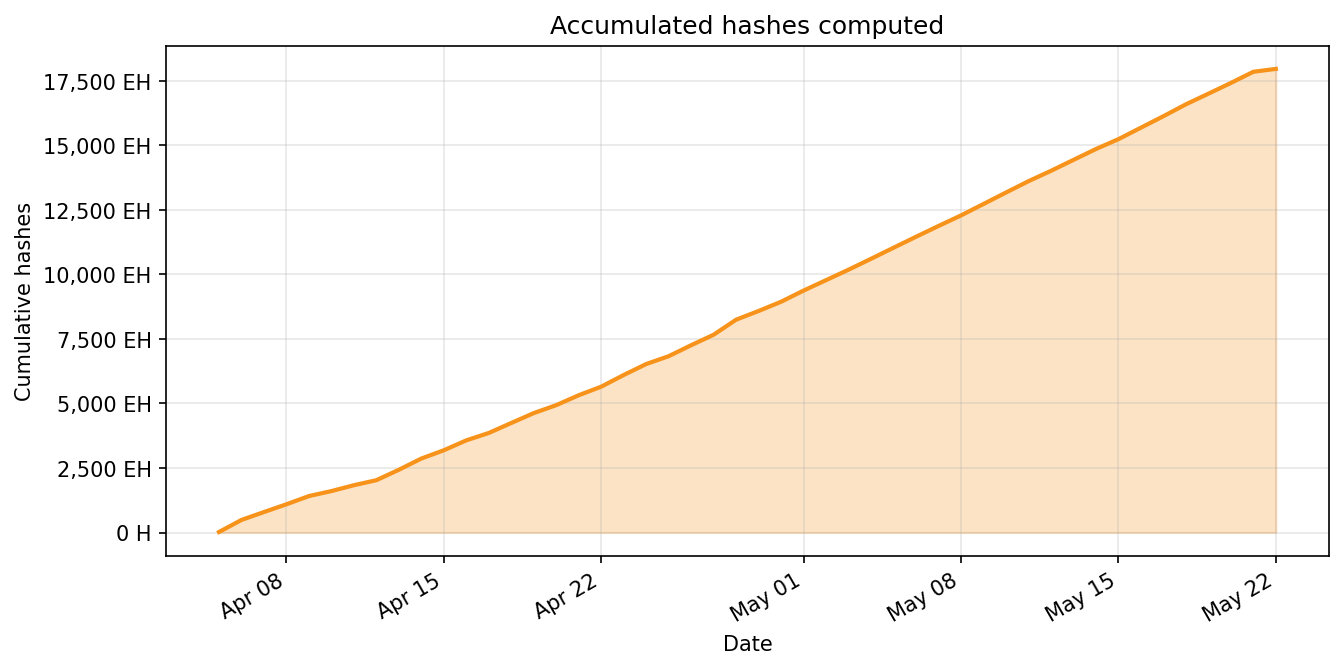
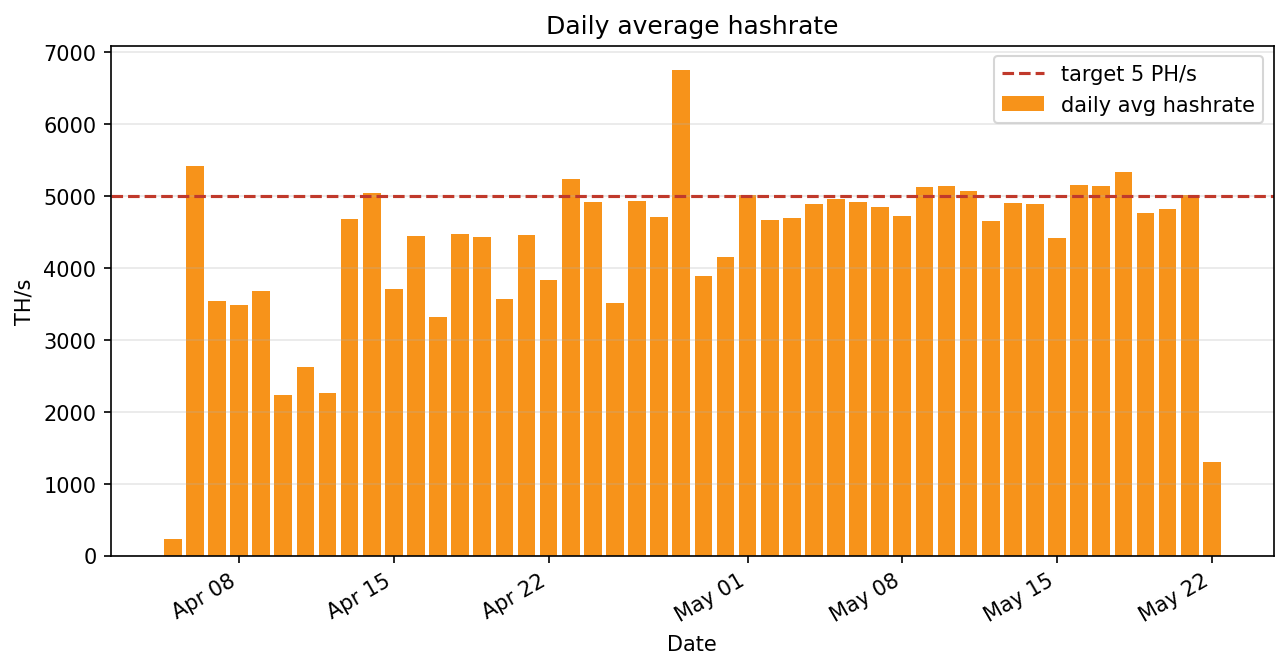
After some initial fiddling, I decided I would settle for a goal of mining at ~5PH/s. I estimated this would allow me to spend my 10 million sats over 6-8 weeks. I wanted to mine at least that long to have a decent statistical chance to getting close to non-extreme luck streaks with OCEAN (either good or bad).
You can see in the chart the first days were more unstable due to this. It also took me a bit of time to get hashbidder properly implemented and operational, hence why I didn't really start tracking the target hashrate great until early May.
Is this enough to amount to anything significant? Well, if I had solo mined at this pace, there is less than 2.5% probability that I would have found a block in less than a year. There is also around a 2.5% probability that if I had mined with the same weight in the network all the way to 2140, I would still have not found a block. Thank God for pooled mining and for OCEAN to make it fair, simple and transparent.
How much did I pay for this? Well, the actual exact amount of money I've spent is not exactly 10,000,000 sats, but rather 9,929,972 sats. The difference is mixed between mining fees I spent sending my money to Braiins and some leftover sats I have still sitting on Hashpower because they're not enough to place an order.
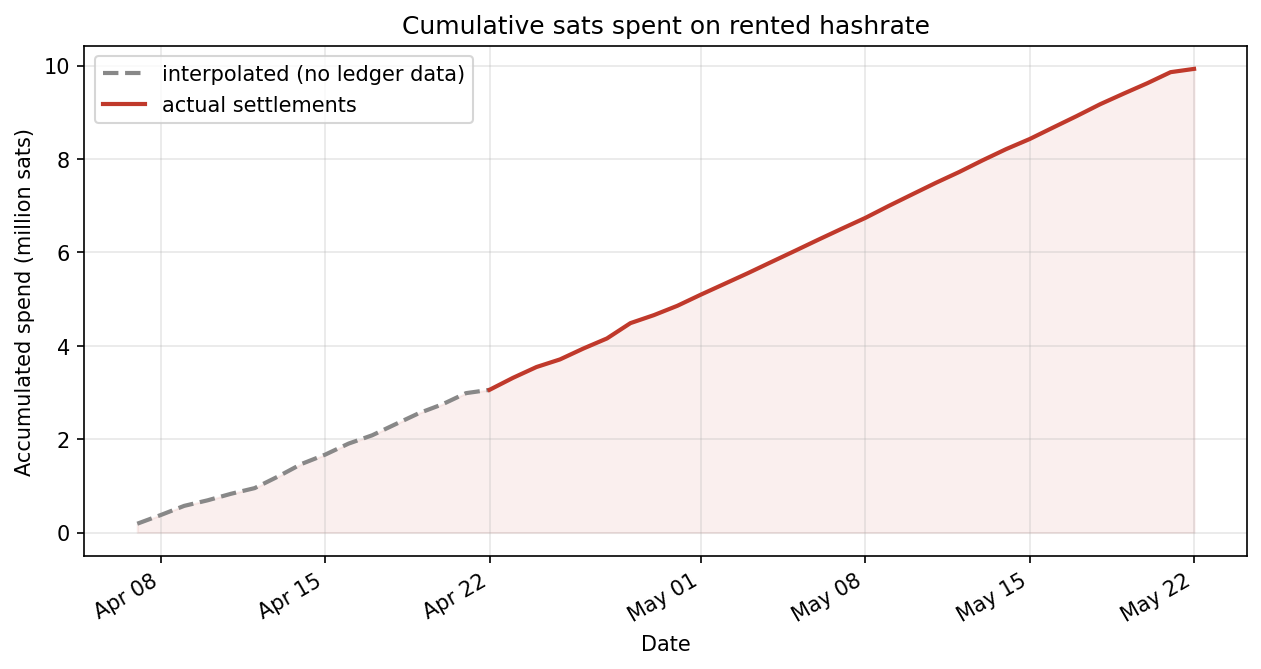
This is a chart showing how my expense accumulated slowly by the day. Unfortunately, it only shows some days because the Braiins API doesn't give you back the full history, hence why you see that interpolated bit at the start. Pretty boring. Stable hashrate, stable expense.
Although it's not a perfectly straight line! Prices do change quite a bit overtime in hashpower. The chart of average sats per PH/s/d shows how the average price fluctuates over different days:
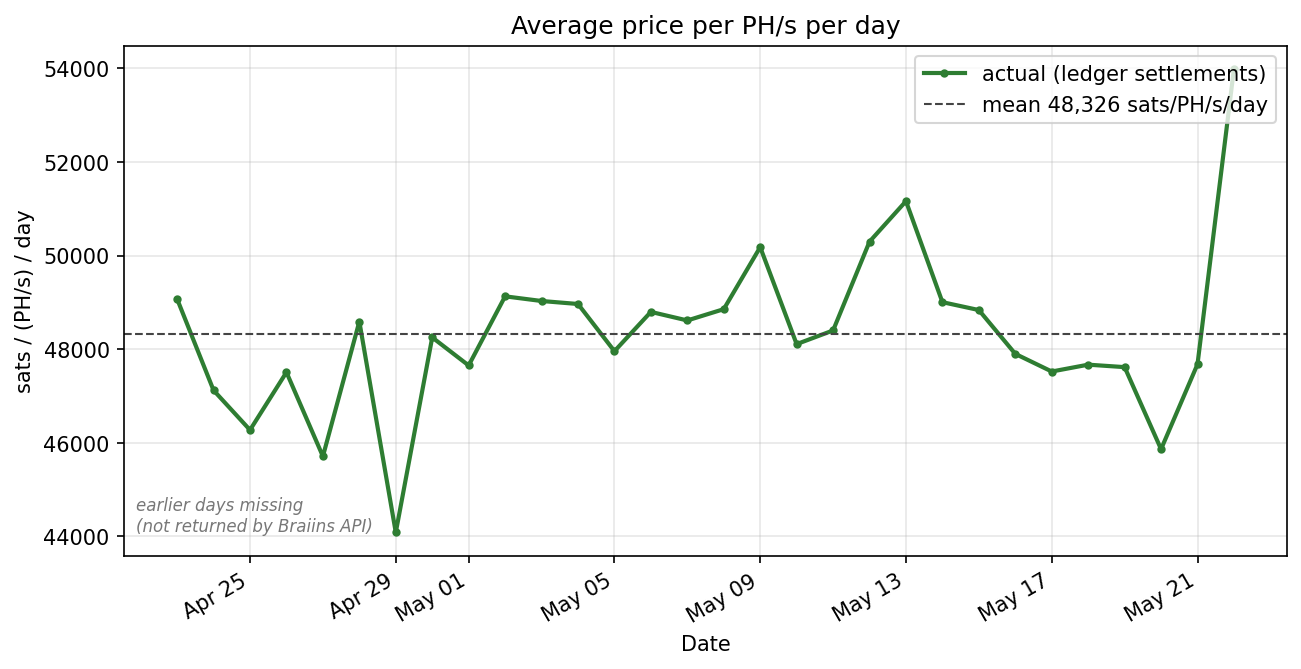
As you can see, prices change significantly measured in sats. Differences of +-20% in a few days do happen.
On the income side: this chart shows the earned rewards day by day (not to be confused with payouts).
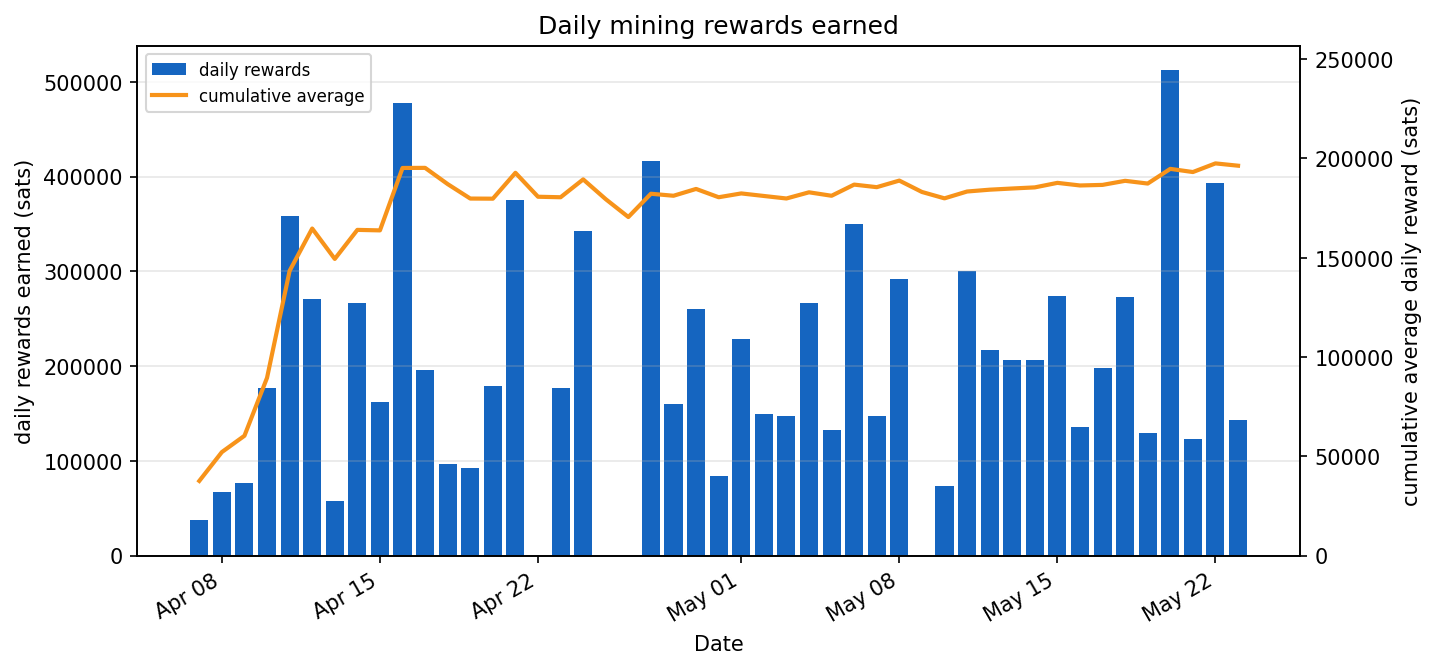
Extremely volatile, as you would expect due to the nature of TIDES, the protocol that OCEAN follows. Having said that, the volatility of this also relates to the size of OCEAN: as they grow their share of the total difficulty, they hit blocks most frequently and wild spikes of luck become less frequent.
This is the chart that should make it clear that mining with OCEAN nowadays for a brief window of time is russian roulette. There are entire days where NOTHING is paid. If you have any hopes of having a stable experience, plan to mine for months at least. The cumulative average line in the chart shows you how, as you stay longer and longer, you start stabilizing on the average.
Finally, this chart sums up the financial performance, showing expense and reward day by day along with the cumulative net loss:
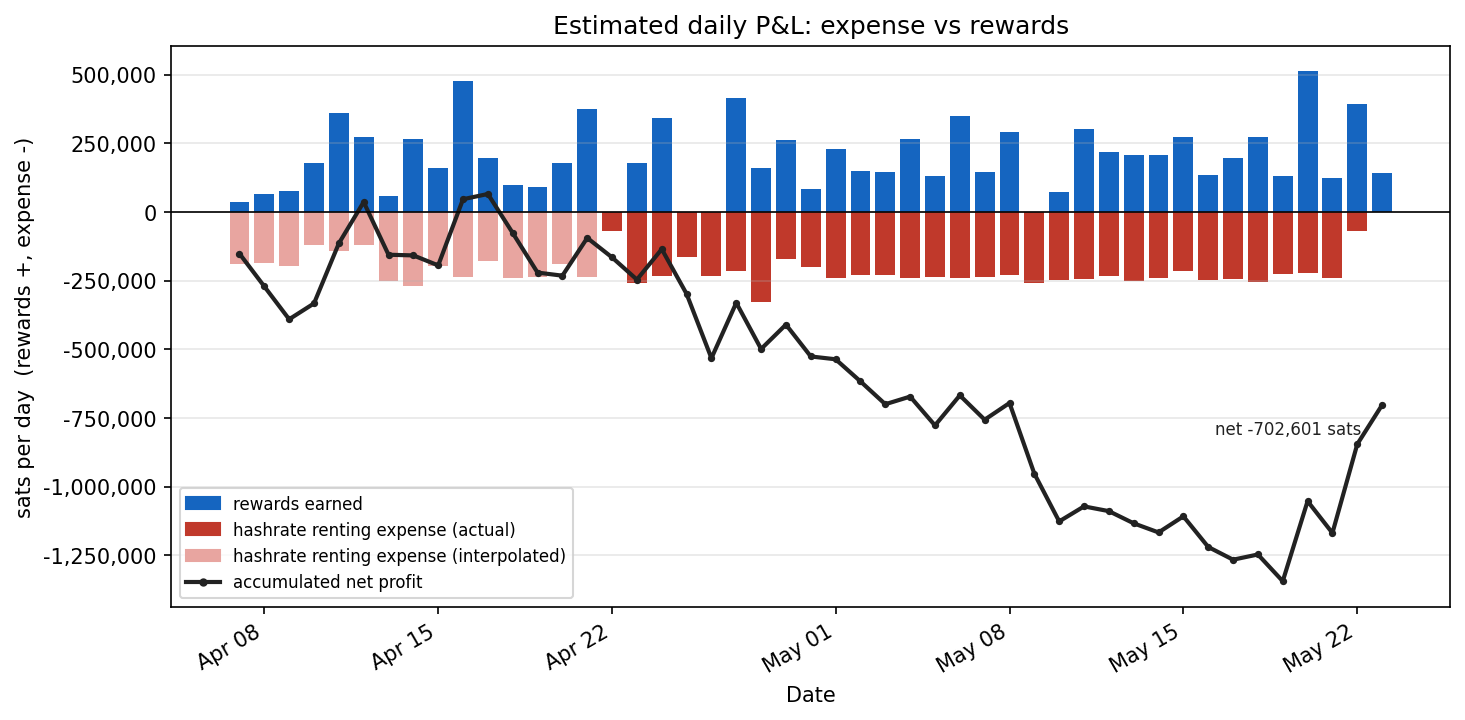
So what does the final P&L look like then?
| Mining experiment P&L | |
|---|---|
| (in sats) | |
| Expenses: | |
| Transaction fees | 817 |
| OCEAN fees | 93,218 |
| Rented hashrate | 9,929,972 |
| Total expense | 10,024,007 |
| Income: | |
| Mining rewards | 9,321,406 |
| Net | −702,601 |
What comes next
So, I poured 10 million sats into this and got roughly 9.3 million sats out, thus spending 700K sats.
Surely it's time to stop, right?

Unhosted Marcellus made this reasoning I find great that if your bags are in Bitcoin, it is in your best interest to keep hash raining on the blockchain tip. He changes the way of looking at mining as a "business" for miners, and rather as a maintenance expense for users (and fees and miners are just a way to organize so that each user doesn't need to run an S21 in their kitchen and risk divorce).
I think it's a good POV. And I'm going to stick to it. I think putting 0.1% of my network, on a yearly basis, towards adding hash is valuable for me. Now that I've run this couple months experiment, I have a good feel for what is the "loss" factor of cycling sats through hashpower, so I can crunch the numbers and find out what is the hashrate I should aim for to spend 0.1% of my bags on a yearly basis.
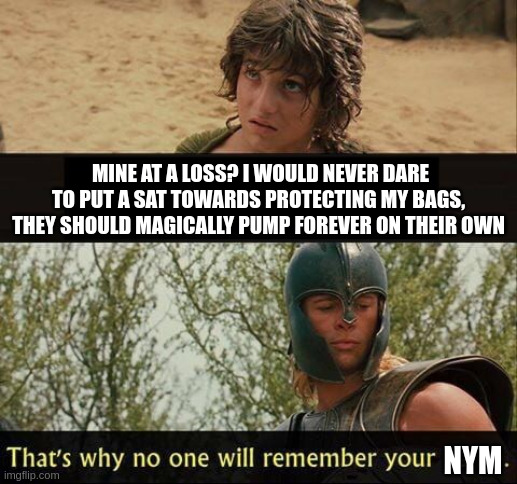
Some fellow Bitcoiners are aware of my plan and have pointed out to me that my actions are pointless. That I'm too small to make a difference in the mining scene. It must suck to have such a terrible low-agency mentality. Pleasure should be found in doing the right things, even if they amount to little.
And you? Will you mine? Why not?